
Essential and desirable job criteria: how to decide whether to apply
Use a four-column worksheet to assess graduate job criteria, identify genuine gaps and decide when to ask the employer for clarification.
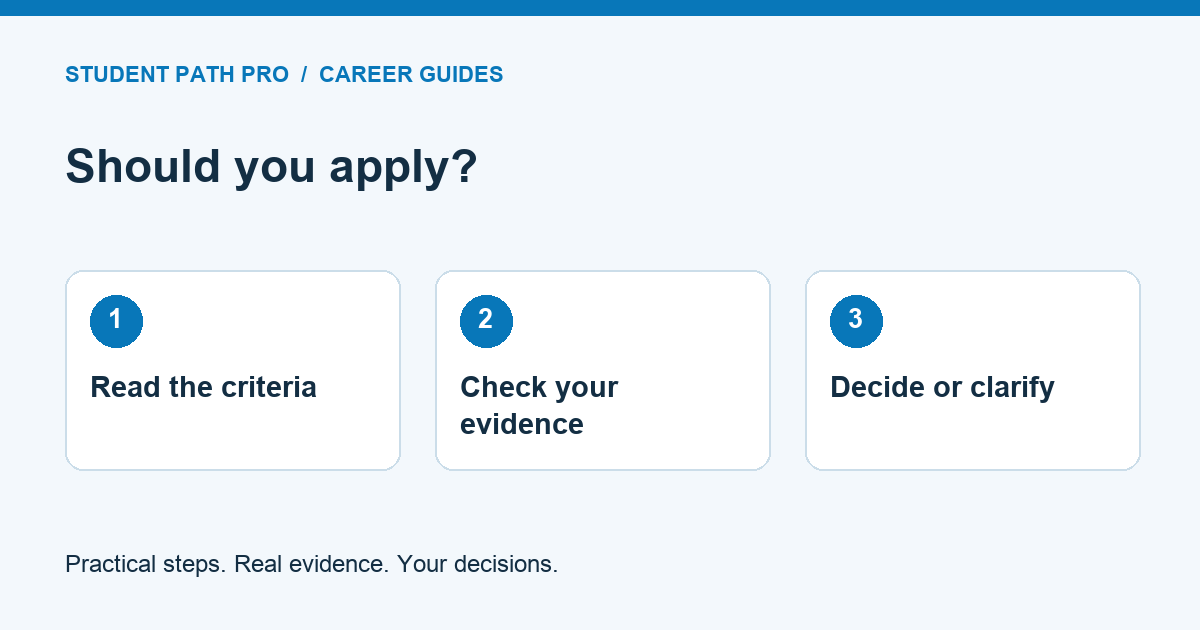
You find a graduate role you would like to do. You meet the degree requirement, recognise most of the duties and have never used the booking system named near the bottom. Before spending an evening on the application, find out where the booking system appears. A duty you would learn on the job, a desirable skill and a condition of appointment call for different decisions.
Read the documents together
Open the full advert, the job description, the person specification and any candidate instructions. The job description tells you what the person will do. The person specification sets out what the employer wants applicants to bring. Save a copy with the closing date. You may need the wording again after the advert disappears.
Look for a heading, a column or a key explaining which requirements are essential and which are desirable. Check the whole row. A column headed “assessed at interview” tells you when the employer expects to see evidence. A column headed “essential” tells you how the employer classifies the requirement. Neither column answers the other question.
The University of Manchester explains that its panels look first for evidence of essential criteria and may use desirable criteria to narrow a strong field. That is a useful example of one employer's process. Read the instructions for the vacancy in front of you before deciding how to allocate your time.
Make a worksheet with a decision in the last column
Use four columns on paper or in a spreadsheet. Copy the exact requirement into the first. Put the employer's classification in the second. In the third, describe the closest evidence you actually have. In the fourth, write the next action. Useful actions include “apply with this example”, “check what equivalent means” and “set this role aside”.
Suppose a fictional events assistant job lists “experience organising activities to deadlines” as essential and “experience using our ticketing platform” as desirable. You coordinated room bookings for a society film night and kept the committee informed when a room changed. You have never used the platform. Those facts belong on separate rows. Your film night may give you a strong example for the first row even though the second remains empty.
Now change the fictional advert. It asks for a specific qualification by the start date and does not mention an alternative. Writing a stronger film night example cannot settle that question. Check your award and dates against the wording. If you expect the award before the stated date, describe that accurately wherever the form asks.
Separate a gap in experience from a gap in wording
“Can communicate information clearly to different audiences” leaves room for several kinds of evidence. You might have explained a change of plan to volunteers and then written a shorter update for visitors. Think through what each audience needed and which details you chose. If you can describe those choices, you have something more useful than a claim that you are a good communicator.
A narrower requirement deserves a narrower answer. Keeping a personal spending sheet is different from reconciling payments against invoices on behalf of an organisation. If the employer requests the latter, record exactly which parts you have done. A related example can help a recruiter understand your starting point. Calling it equivalent yourself leaves the reader with an inaccurate account.
Ask one question when the answer would change your decision
If a listed contact invites vacancy enquiries, identify the precise uncertainty. For example, “The specification asks for experience coordinating public events. Would a ticketed event run through a university society count as a setting you consider?” The employer can answer a question about the scope of its requirement without having to assess your entire application by email.
If the answer would not change your decision, spend the time preparing the application instead. Keep track of any clarification alongside the advert and note who provided it. Avoid relying on advice for a different role at the same organisation. Teams can recruit for different responsibilities under similar job titles.
Decide what to do with the result
Apply when you can make a credible case for the essentials and the role fits your circumstances. A missing desirable item can remain a gap. Where the application invites you to discuss development, you can name relevant experience and explain what you would need to learn. Never imply that reading about software is the same as using it in a job.
When a genuine essential requirement rules out this particular vacancy, save the wording. Compare it with two other advertisements for work you would like. If the same requirement appears repeatedly, it gives you a concrete development question. If it appears only in this role, you may get more value from looking at a different employer than from starting a course immediately.
Carry the useful rows into the application
UCL's candidate guidance asks applicants to explain how they meet its requirements with examples. Follow the particular form's headings and word limits. Turn your best evidence into a short account of what you personally did and what happened. Keep the worksheet as your planning document. The recruiter needs the relevant examples in the submitted material.
Use our CV tailoring guide when an application asks for a CV. Record your decision, the deadline and the version you sent using our graduate application tracker guide. The finished worksheet should answer a practical question: can you show the employer enough relevant evidence to give this application your time?