
How to put university society experience on your CV
Turn university society responsibilities into precise CV bullets with practical examples for events, customer support and operations roles.
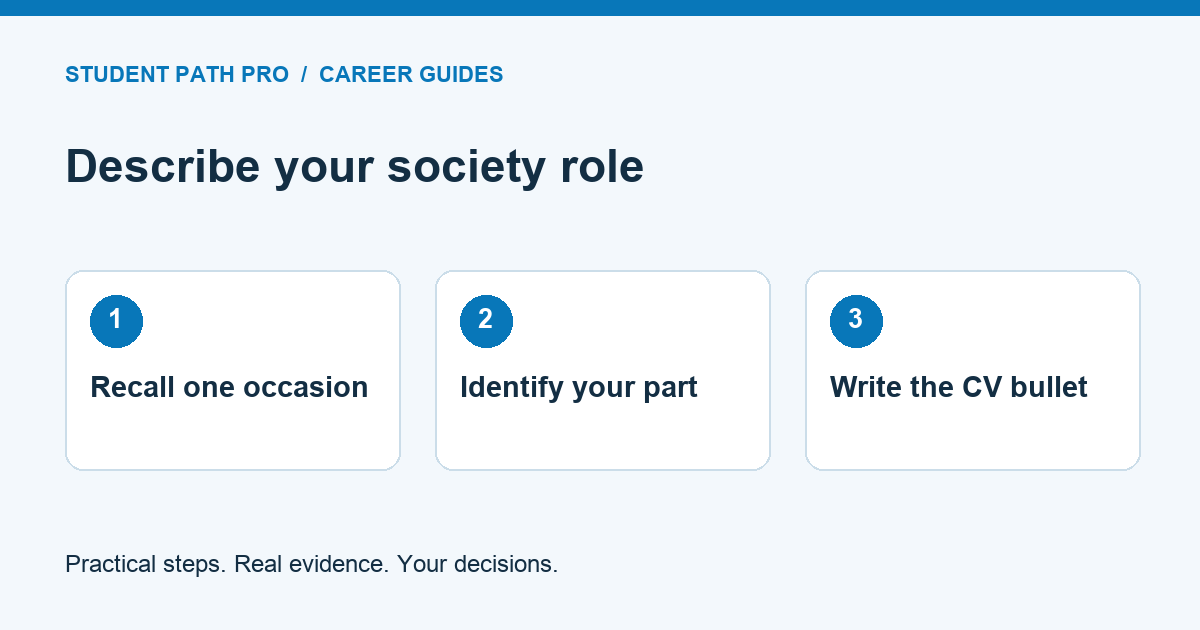
A committee title leaves a recruiter with several unanswered questions. A society secretary might have taken minutes, handled room changes, answered questions from new members or done all three. Start with one occasion you remember well enough to describe. The right CV entry helps the reader understand what you contributed and why it matters for the role you want.
Reconstruct a specific piece of work
Think about the last time someone relied on you. Perhaps a speaker cancelled, two volunteers expected the same shift or a new member could not find the venue. Write down what was happening before you stepped in, what you were responsible for and what happened next. Use ordinary language that a person outside the society could follow.
Look at an event plan, a rota or a handover note to refresh your memory. These are prompts for your own writing. You can usually explain the work without naming individual members or sharing private committee records. Keep a note of which details you can verify and leave out numbers you cannot reconstruct.
Find the part that belonged to you
Imagine a society committee organised a panel discussion. One member invited the speakers, another booked the venue and a third managed the desk on the day. All three helped run the event. Their CV entries should tell three different stories. The person at the desk might describe briefing volunteers and directing late arrivals. They should leave speaker recruitment to the person who did it.
Shared responsibility can be precise too. “Agreed a revised running order with the events lead and circulated it to speakers” identifies a decision made together and an action taken personally. If you were working to someone else's plan, say which part you implemented. A clear account of a small responsibility is easier to discuss at interview than an expansive account you cannot support.
Draft the bullet from the reader's point of view
Begin with an action, add the object of that action and finish with a detail that explains its purpose or result. “Updated the volunteer rota after two shift changes and sent each volunteer their arrival time” lets a reader see the coordination involved. “Excellent organisation and leadership skills” leaves them to imagine an example.
Use numbers when they establish something meaningful that you know. A rota covering four rooms tells a reader about the coordination problem. A percentage increase in attendance needs a reliable starting number, an ending number and a basis for linking the increase to your work. If you simply know the event went ahead on time after a room change, that observed outcome can carry the sentence.
Choose evidence for the vacancy
Suppose you are applying for a customer support role. The useful part of a society welcome event might be the questions that kept coming up. An illustrative bullet is “Collected recurring questions at the welcome desk and rewrote the joining instructions to explain fees and meeting times.” Use that wording only if those were your actions. A recruiter can now ask how you noticed confusion or chose what to change.
For an operations role, the same event could call for different evidence. “Checked room capacity against registrations and flagged a shortfall to the committee before bookings closed” shows a specific check and escalation. You do not need to imply you secured a larger room if another member handled that decision. Oxford's careers guidance encourages applicants to choose evidence that fits the criteria. Your choice of incident does much of that work before you edit a word.
Put the entry where the reader can find it
If this is one of your strongest examples of relevant responsibility, an experience or volunteering section can give it room. Use the organisation, role and dates, followed by one or two focused bullets. Make the voluntary nature clear. If you attended meetings and enjoyed the subject without holding responsibilities, a short interests entry may tell the story more accurately.
Translate any internal title a reader would struggle to understand. Keep an official title if you want, then add a short explanation of the remit. Check that the dates reflect when you held the role. Membership might have started in first year while your work as treasurer began in second year. Those are different facts and the entry should make the distinction easy to see.
Keep a longer version for interview
Save a private note with the background, one tricky decision, your contribution and the outcome. The CV bullet can stay brief because this note preserves the detail. Practise answering a follow-up such as “What would have happened if you had missed that check?” or “Which part would you handle differently next time?” These questions can reveal an overclaim before you send the CV.
The University of Sussex includes society and sports team experience among the places students can draw application examples from. Use our CV tailoring guide to choose which evidence belongs in a particular application. When you update the version in your CV Workspace, read the bullet aloud once more. A reader should be able to tell what the society did, what you did personally and which detail makes your contribution relevant.