
How to tailor your CV to a job description without inventing experience
Learn how to tailor your CV to a job description using real projects and experience, with an evidence map, honest examples and a final review checklist.
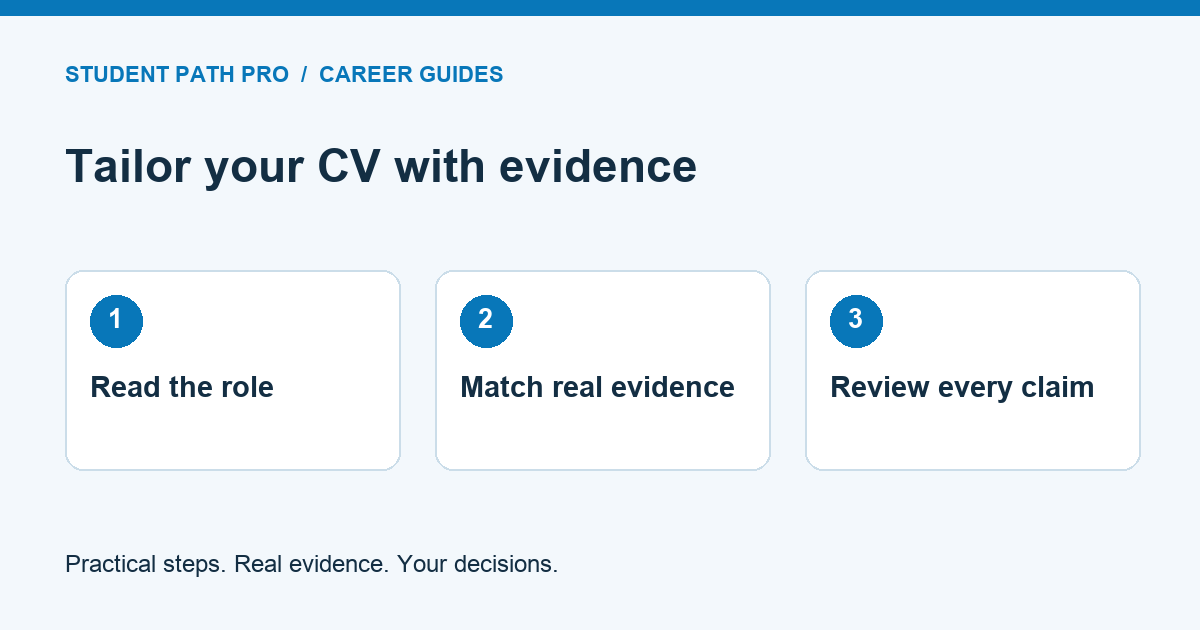
Tailoring your CV means choosing and explaining real evidence that matters to a particular role. It does not mean copying every phrase from an advert or making your background sound more senior. For students and recent graduates, the useful question is: which parts of my studies, work, volunteering or projects show that I can do this work?
This guide gives you an evidence-first editing method. You will finish with a clearer CV, a record of the changes you made and an honest list of gaps. The worked examples are fictional illustrations, not candidate results or promises of interviews.
Start with the employer's instructions
Save the full job description, person specification and application instructions before editing. Note the requested file format, any word limits and whether the employer wants a CV, an application form or both. Follow those instructions ahead of any generic template.
The National Careers Service recommends tailoring a CV to the opportunity and reviewing the advert's requirements. Use its CV guidance as a general reference. Our workflow below adds a practical evidence map so that each edit has a reason you can explain.
Do not start by changing your job titles. A placement, society responsibility or university project should retain its real name and context. Clear context helps a recruiter understand the scale of your contribution.
Make a requirement-to-evidence map
Create three columns in a document: requirement, evidence and decision. Copy a short requirement into the first column. In the second, describe a real occasion when you used that skill. In the third, write include, clarify or gap.
Imagine an entry-level operations advert asks for spreadsheet skills, organisation and customer communication. A fictional student might have checked a society attendance list, organised a committee rota and answered questions in a part-time shop role. These are separate pieces of evidence. They should not become a claim that the student managed an operations department.
Distinguish essential requirements from preferences. If an advert requires a qualification you do not have, a different keyword will not resolve the gap. Check whether the employer accepts alternatives, and use its contact route if the wording is genuinely unclear.
Choose the strongest relevant examples
Your master CV can hold more detail than the version you submit. Keep a private evidence bank containing projects, responsibilities, tools, feedback and outcomes. Select the examples that best support this particular application instead of squeezing everything onto the page.
For each example, ask what you personally did, what you used and what happened. If you cannot answer those questions, the bullet may need checking. Team achievements are valid, but your own contribution should be visible.
A dissertation may demonstrate research and analysis. A club event may show coordination. Paid work may provide examples of reliability or customer communication. None automatically proves every skill in the advert. Explain the connection instead of expecting the reader to infer it.
Rewrite a bullet using evidence
A vague fictional bullet might read: Helped with a university society event. A clearer version could be: Maintained the event booking spreadsheet, checked duplicate entries and shared an updated attendee list with the organising committee.
The second version identifies an action, a tool and a useful output. It does not add an invented attendance figure, revenue increase or leadership role. If the student also has a reliable record of attendance, that verified figure could be relevant. A number is optional; truth is compulsory.
Avoid replacing every ordinary verb with a grander one. Supported, checked, organised and explained can describe worthwhile work accurately. Led is appropriate when you actually led the activity, not because it sounds stronger.
Use the employer's language carefully
When an advert asks for Microsoft Excel and you used Excel, name it. When it asks for stakeholder communication, explain who you communicated with and why. Matching terminology can make your evidence easier to recognise, but repeated keywords cannot substitute for the underlying experience.
Do not add hidden text, lists of unrelated software or a claim of expertise based on a single tutorial. If you are learning a tool, describe that honestly and separate learning from workplace use. There is no universal keyword score that guarantees an interview.
Read the finished sentence aloud. If the wording sounds unlike anything you could comfortably explain in an interview, simplify it and check the claim.
Adjust emphasis, then check consistency
Reorder relevant bullets and sections so the strongest evidence is easy to find. A graduate with a highly relevant project might give that project more space. Someone with directly relevant employment may lead with their experience. Choose the order that makes the application understandable.
Keep dates, qualification names and job titles consistent across your CV, application form and cover letter. Tailoring should change emphasis, not history. If you correct an error in your master record, update the other documents too.
A short profile is useful only when it says something specific. Replace generic claims such as highly motivated team player with a concise description of your current background, relevant evidence and intended direction.
Save a version you can defend
Before submitting, check spelling, contact details, links, formatting and the employer's file instructions. Open the exported file to confirm that the text is readable and the layout has survived. Ask a trusted reader whether the connection between your examples and the role is clear.
Save the final CV with a useful filename and record which role received it. Keep the original advert beside it so you can prepare for an interview using the same evidence. Our graduate application tracker guide explains a simple way to maintain that record.
SPP's CV Workspace is designed to keep role-specific CV preparation together. Review any suggested wording against your own experience before using it, and check current pricing for service access. Account creation and paid tool access are different things.
Final review questions
Can I explain every claim with a real example? Have I made my own contribution clear? Did I follow the employer's instructions? Have I acknowledged gaps instead of disguising them? Can I find the exact version I submitted?
If those answers are clear, your CV is better prepared for this role. Tailoring cannot guarantee a response, but it can make the evidence you already have easier to understand.