
How to make a first-job career plan when two paths look plausible
Compare two graduate career paths with real job adverts, small practice tasks and a review date. Includes a worked example for a biology graduate.
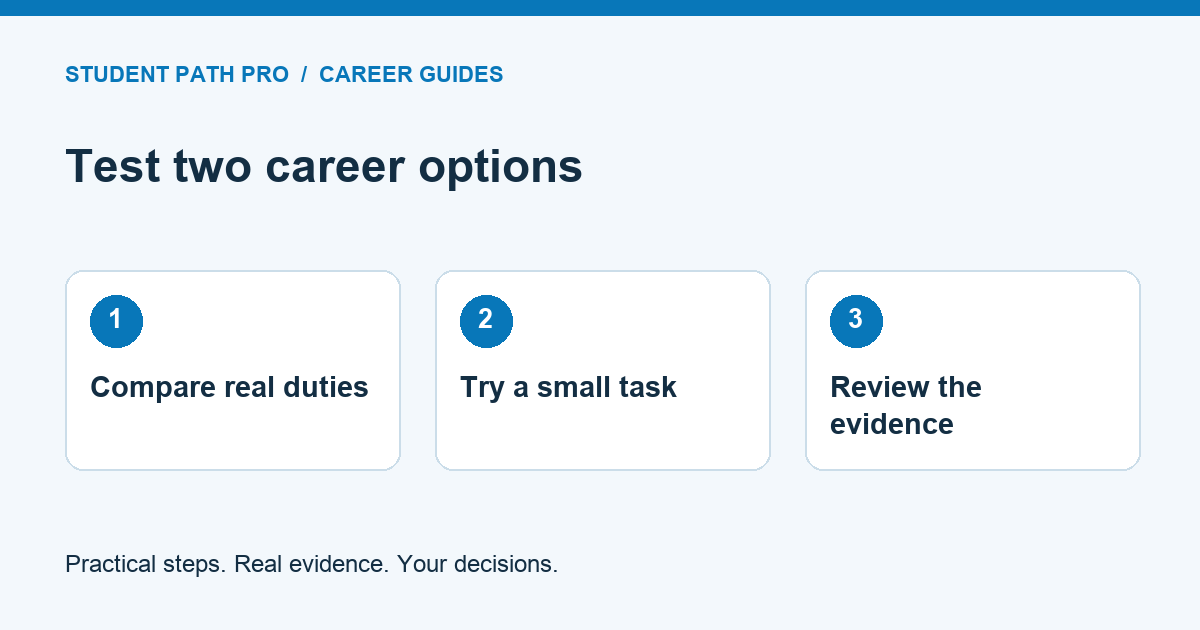
Suppose a biology graduate enjoys explaining complicated ideas and also likes organising practical work. Science communications and project support both sound plausible. Picking the title that looks more impressive will tell them little about which working day they would prefer. A first-job plan can start with a smaller decision: what could they do this week to learn something that would change their shortlist?
Start with one choice you can test
Write down two kinds of work, one question about each and a review date. Be specific enough to find real examples. “Writing patient information for a health charity” gives you something to investigate. “A creative career” could mean dozens of very different jobs. Give yourself permission to change the wording once you have read a few advertisements.
Alongside the question, write the conditions that shape your search. These might include a minimum income you have calculated from your own costs, places you can travel to, or hours that fit caring responsibilities. Separate a firm constraint from a preference. If you can commute twice a week but cannot relocate, two roles with similar duties may still lead to different decisions.
Collect evidence from ordinary tasks
Look back at a recent assignment, shift or volunteer activity. Which part would you willingly do again, and which part took more effort than you expected? Write down what actually happened. “I enjoyed rewriting the introduction after two classmates said the diagram was unclear” tells you more about your preferences than “I am creative”. It also suggests a task you can repeat under different conditions.
The National Careers Service suggests taking stock of your skills when making a career plan. Include activities outside paid employment if they give you relevant evidence. If you organised a society event, distinguish enjoying the event itself from enjoying the preparation. You might have loved talking to visitors but disliked rearranging the rota. Our society experience guide can help you separate your own contribution from the group's work.
Read adverts for the working day behind the title
Find two vacancies for each option if you can. Record a recurring duty, the people it involves and one point the advert leaves unclear. For the fictional graduate, a communications role might involve checking copy with technical specialists. A project support role might involve chasing updates from colleagues. Both involve communication, but the conversations have different purposes.
Keep a separate line for entry requirements. Use our job criteria guide if you are unsure how to interpret a person specification. A vacancy that requires a qualification you do not hold can still tell you about an occupation. Mark it as research so that it does not get mixed up with jobs you intend to apply for. Save the date and employer because advertisements can disappear.
Run a small experiment for each option
For the writing option, choose a public science explanation, identify its intended audience and draft a shorter explanation in your own words. Ask someone in that audience what they understood and where they had to reread. Record the part of the revision you found satisfying, the part that frustrated you and the time it actually took. A single exercise gives you a starting observation to compare with other evidence.
For the project option, plan a modest event for a group you already belong to. Agree the outcome, list dependencies and ask another organiser to look for a missing step. If there is no real event, use a fictional one and label it that way. Compare how you felt about sorting dependencies with how you felt about rewriting the explanation. Neither exercise requires an employer to share confidential material or promise work experience.
Ask about the part a practice task cannot show
A short conversation with someone doing the work can help answer a narrow question. Instead of asking them to describe their whole career, try “What usually happens to a draft after you send it to a specialist for review?” or “When two project deadlines conflict, who decides what moves?” Ask for a few minutes and make it easy to decline. Take notes about the tasks they describe and the setting in which they do them.
Treat one person's experience as one example. A small charity and a large agency may use the same title for jobs with different responsibilities. If their account contradicts an advertisement you read, save the difference as a question for your next conversation. You do not need to average the two accounts or choose one as universally correct.
Put a decision on the calendar
On your review date, return to the question you started with. Write three lines: the option you will pursue first, the observation that influenced you most and the uncertainty that remains. The biology graduate might choose to try communications applications because they enjoyed revising material after feedback, while still wanting to understand how publication deadlines affect the job.
Finish with an action you can complete. Save one suitable vacancy, arrange a careers appointment or repeat the exercise with a different audience. Give the action a date and keep your notes. If you later change direction, those notes will show whether your circumstances changed, you learned something new about the work, or the first job you examined was an unusual example.