
Graduate interview preparation: a seven-session plan you can adapt
Prepare for a graduate interview with seven adaptable sessions covering evidence, research, practice, questions and practical arrangements.
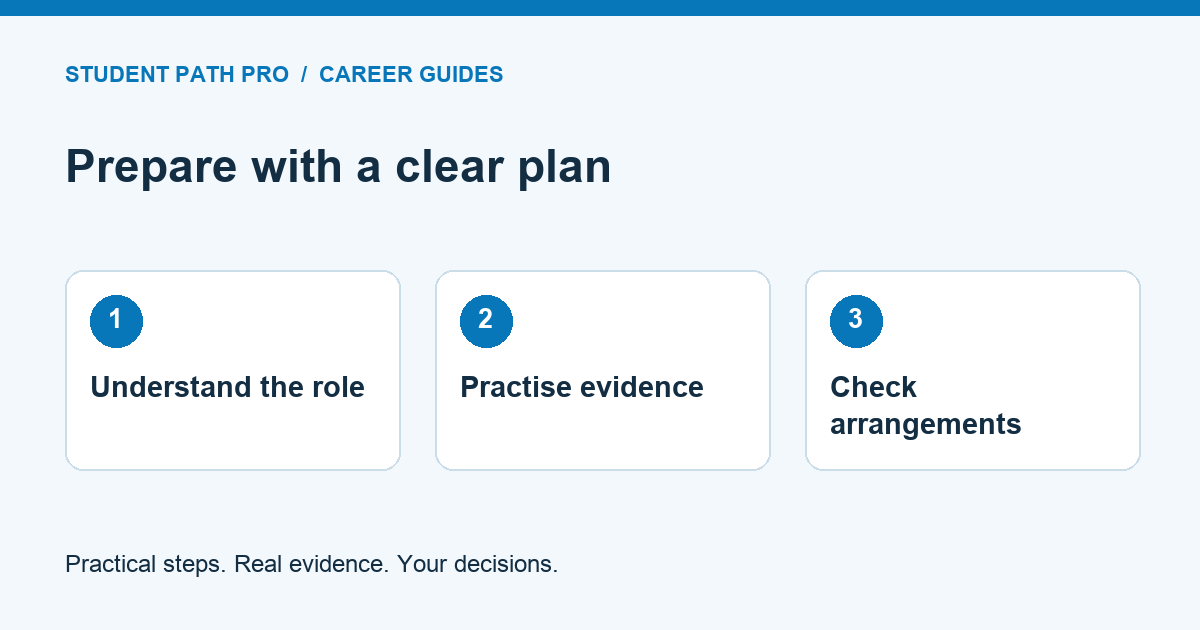
Interview preparation becomes easier when it produces a few useful outputs rather than an ever-growing reading list. You need to understand the advertised work, recall relevant evidence and handle the practical arrangements. You also need enough flexibility to answer the question actually asked. Memorising a script for every possible question can make it harder to listen and respond naturally.
The seven sessions below are an original planning framework. They are not a required timetable or a guarantee of success. Spread them over the time available, combine them if an interview is close and repeat whichever session reveals a real gap. An employer’s invitation and assessment instructions take priority over any general preparation plan.
Session one: decode the invitation
Read the invitation from beginning to end. Record the date, time zone, location or joining link, expected duration, format and any preparation task. Identify whether you will meet a panel, complete an exercise, deliver a presentation or record answers. Keep the contact details for practical questions somewhere accessible without having to search through your inbox on the day.
Make a short uncertainty list. If the invitation does not explain a necessary detail, ask a concise question through the stated contact route. Where you need an adjustment, use the employer’s process and discuss what would help you participate. You do not need to guess what equipment, software or presentation format will be accepted. Resolve those questions early enough to make a workable plan.
Session two: map the role to evidence
Re-read the exact CV, application form and cover letter you submitted. Put the job description beside them and identify the main responsibilities and assessment criteria. For each important criterion, select one example you could explain. Include the setting, your individual action, the result you can support and what you learned. Note where an example is transferable rather than directly equivalent to the advertised work.
Do not make every answer depend on a single project. A small evidence bank drawn from coursework, employment, volunteering or other responsibilities gives you more choice. Our job criteria guide can help with interpreting the requirements, while the CV tailoring guide provides a useful reminder to keep claims consistent. If you discover an error in your application, prepare to correct it plainly rather than building an answer around it.
Session three: research with a purpose
Start with the organisation’s own pages, the role advert and any material supplied with the invitation. Identify what the organisation does, whom it serves and how this role contributes. Distinguish confirmed information from your interpretation. Record the page and date for a fact you may mention, especially if the organisation is changing its services or structure.
Limit your notes to information you can use. A useful output is three connections: one reason the work interests you, one way your experience relates to it and one question that would help you understand the job. Reading every press release is less valuable than being able to explain those connections. Avoid assuming that a company value printed on a website proves what everyday working life is like.
Session four: practise explaining actions
Choose two or three evidence examples and answer a question aloud. Describe enough context for someone outside your course or workplace to understand the task, then focus on what you did. Explain a decision, a difficulty or a trade-off. Finish with the result and any learning relevant to the question. A structure can support clarity without becoming a script you must recite.
Record one practice answer if you are comfortable doing so. Listen for unclear references, unnecessary background and claims that sound broader than the evidence. For a team project, replace an ambiguous “we did everything” with a clear account of your contribution and collaboration. Practise a second version using different words. The aim is to know the evidence well enough to adapt, not to reproduce a perfect recording.
Session five: practise the actual format
Preparation should reflect the assessment you have been told to expect. For a technical interview, work through relevant problems and explain your reasoning, including assumptions and checks. For a presentation, practise within the stated time and keep a backup in the permitted format. For a case exercise, separate the information supplied from assumptions you introduce. Do not use confidential material from a previous employer or project.
For a video interview, test the device, connection, microphone and camera you intend to use. Check the platform instructions and arrange a reasonably quiet setting. National Careers Service guidance distinguishes live from recorded video interviews and recommends technical preparation. If the format allows notes, keep them brief enough that you can maintain attention. Follow any rules about assistance or external tools during the assessment.
Session six: prepare questions that matter
An interview is also a chance to understand the opportunity. Prepare questions about the work, early expectations, feedback, supervision or training that are relevant to your decision. Cambridge Careers highlights questions about the role and development as useful preparation. Use your research to avoid spending the whole question period asking for information already clearly supplied.
For example, you could ask how a new graduate receives feedback during an initial project, or what a typical first assignment involves. Treat the answer as evidence to consider, not as a promise of a universal experience. If the interviewer has already covered your planned question, acknowledge that and ask a related clarification. You do not need to force every prepared question into the conversation.
Session seven: simplify the day
Check travel time or the joining link again, gather any requested documents and decide when to stop preparing. Keep essential contact details available in case of delay or technical trouble. Review a single page containing the role’s priorities, a few evidence reminders and your questions. A final frantic search for new facts can crowd out information you already understand.
During the interview, listen to the whole question. Ask for clarification if necessary, take a moment to organise your response and be honest when you do not know something. Afterwards, record what was discussed, any next steps and points you would improve for another interview. Update your graduate application tracker without marking an outcome that has not been confirmed. Preparation can improve how clearly you present your evidence; the employer still makes the hiring decision.