
Graduate scheme or direct-entry job: compare the actual offer
Compare graduate schemes and direct-entry jobs using real duties, supervision, learning and practical conditions.
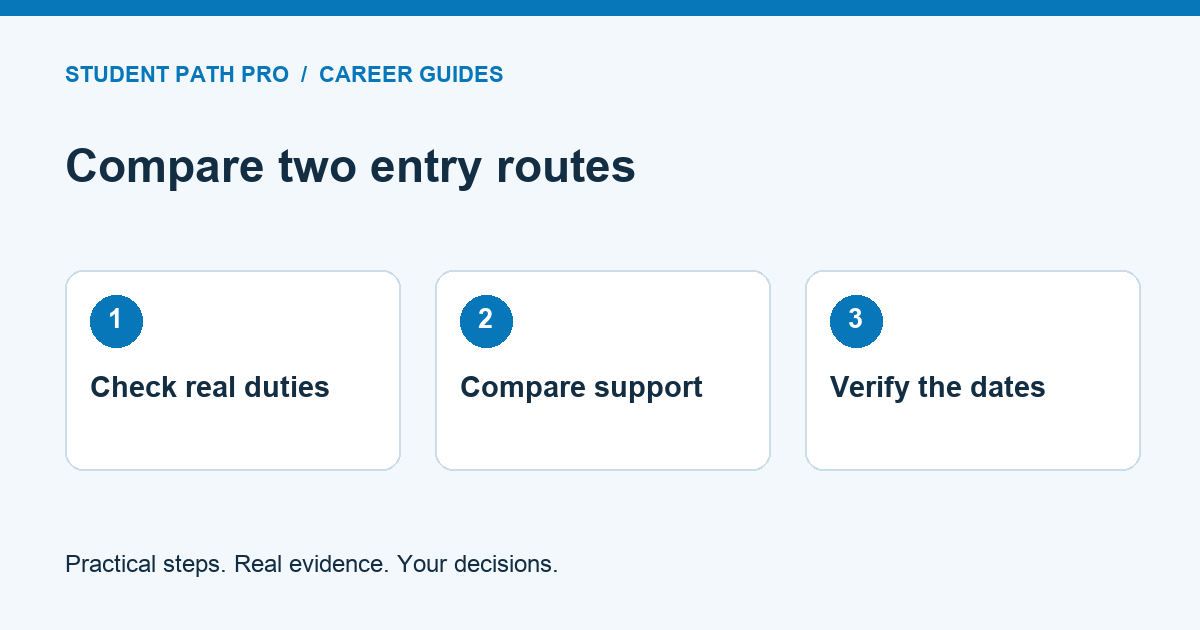
A graduate scheme and a direct-entry job can both be sensible first steps after university. The useful question is which particular opportunity gives you work you want to learn, support you can use and conditions you can sustain. A familiar employer name or the word graduate cannot answer those questions. This guide gives you a comparison worksheet and a way to investigate missing details before you invest hours in an application.
Start with two real vacancies
Choose one scheme and one direct-entry vacancy in a related area. Save each employer's advert, job description and application instructions with the date you checked them. Avoid comparing a detailed vacancy with an imaginary ideal scheme. For each option, write down the work you would actually do in the first six months. If the advert says only that you will develop commercial awareness, record that as an unanswered question rather than a specific responsibility.
Oxford's careers guidance distinguishes structured graduate programmes from recruitment into individual positions. Its guidance also notes that scheme recruitment can begin well before the start date. Those are useful search patterns, not universal rules. Use the employer's current listing for deadlines, eligibility and start dates. A role labelled analyst, assistant or coordinator may be relevant even when graduate does not appear in its title.
Compare learning, rather than labels
Create a worksheet with six rows: daily work, supervision, formal learning, team exposure, practical conditions and next-step options. Give each opportunity its own column. Put evidence in every cell, including the source or person who supplied it. Mark unknown details with a question mark. Do not give an unknown feature a positive score just because the organisation has a large recruitment website.
Under supervision, look for who checks your work and how feedback happens. Under formal learning, distinguish an actual course or qualification from a general promise of development. Under team exposure, ask whether rotations are guaranteed, optional or subject to business need. A permanent role in one team may provide excellent learning; a rotation may be valuable or poorly matched to your interests. The arrangement matters more than its name.
Make the practical conditions visible
Record the advertised pay, working location, attendance expectations, contract duration and expected start date. If relocation is involved, estimate costs using your own likely circumstances. Note questions about travel, equipment or professional study support without assuming that the employer will cover them. Keep employment and eligibility questions separate from your preference score. An attractive learning plan does not resolve a condition you cannot meet.
Check the employer's exact eligibility wording. Degree subject, classification, graduation window and other requirements vary. Use the job criteria guide to separate stated requirements from preferences and to identify questions that genuinely need clarification. If a requirement is unclear, quote the relevant line in a concise enquiry. Do not assume a scheme accepts every graduate or that a direct-entry role requires previous full-time employment.
Work through a fictional comparison
Imagine Priya, a final-year geography student, comparing a business operations scheme with an operations assistant vacancy. The scheme describes three placements but does not explain how teams are allocated. The assistant role lists reporting, supplier coordination and a weekly meeting with the operations manager. Priya has enjoyed organising society events and checking attendance data, but has not yet tried supplier work.
Her worksheet identifies two different uncertainties. For the scheme, she needs to understand rotation allocation and what happens afterwards. For the assistant job, she needs to ask how a new starter learns the reporting systems. She does not rank the scheme first simply because it has rotations. She drafts two specific questions, then checks whether the application process provides a suitable place to ask them.
Ask questions that change a decision
Useful questions include: what would a successful first three months look like; who reviews a new starter's work; how are assignments allocated; and which training is scheduled rather than available on request? Ask only the questions whose answers are missing from the material supplied. An employer may not be able to guarantee a future team or promotion, so record the limits of the answer as well as its positive points.
Keep questions focused and easy to answer. Instead of asking whether the culture is good, ask how the team supports someone learning a particular task. Instead of asking whether progression is fast, ask what evidence is used when reviewing responsibility. These questions help you compare observable arrangements without turning uncertain future outcomes into promises.
Plan applications around real dates
Record the closing date, any rolling recruitment statement, required documents and selection stages for each vacancy. Do not assume that every scheme closes in autumn or that every direct-entry vacancy needs an immediate start. If you are not available until after exams, check the stated start date before preparing a lengthy application. Save the listing because details may change while recruitment is open.
Use the graduate application tracker guide to record what you submitted and the next action. Allocate preparation time according to the actual tasks: an application form, a tailored CV, a test or an interview. Reuse your evidence notes carefully, but write each answer around that employer's requirements. Applying through both routes can be reasonable when both contain opportunities you would genuinely consider.
Make a provisional choice and review it
Finish by writing three sentences: which option currently fits best, what evidence supports that judgment and what unanswered question could change it. This keeps the decision open to new information without leaving it vague. You can revisit the worksheet after an interview or offer. Choosing a route is a practical decision about the opportunities available to you now, not a permanent verdict on the rest of your career.